
The Lululemon Specify Coat: A Useful and Biomechanical Analysis of Ath…
페이지 정보
작성자 Mason 작성일26-07-30 09:23 조회9회 댓글0건관련링크
본문
Abstract
This short article checks out the lululemon sweat rep tank (Read More On this page) Define Coat through a scientific lens, examining its layout, material structure, and biomechanical performance. As a noticeable athletic garment, it exemplifies just how efficiency wear bridges athletic utility and lifestyle applications. We examine its technological requirements, thermoregulatory residential properties, and ergonomic design to illuminate its multifunctional function in modern activewear.
1. Introduction
The Lululemon Specify Coat stands for a paradigm shift in athletic outerwear, combining compression modern technology with versatile capability. Developed largely for high-intensity training yet adopted widely in informal contexts, it reflects progressing consumer needs for hybrid clothing. This article deconstructs its design, making use of materials scientific research and biomechanics to evaluate its efficiency features. We evaluate its structural effectiveness in boosting sports performance while resolving thermal management and movement restrictions typical to conventional outerwear.
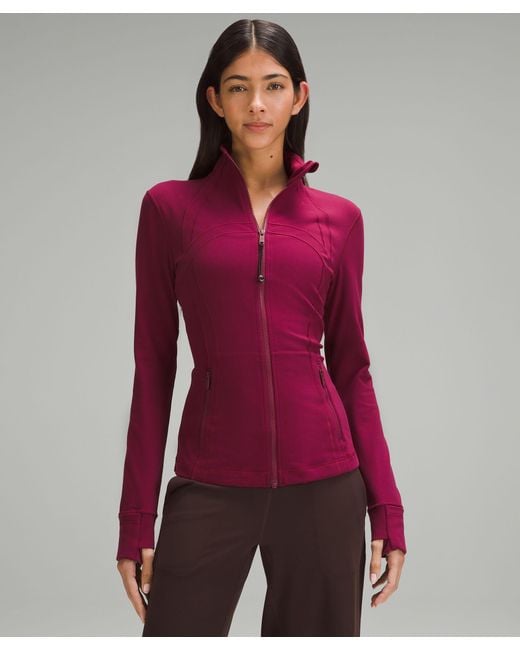
2. Product Structure and Practical Residences
Created largely from exclusive textiles like Luon ® or Nulu ™, the Specify Jacket uses artificial blends (typically 84% nylon, 16% Lycra ® elastane). These products display crucial useful attributes:
- Wetness Administration: Hydrophobic nylon fibers create capillary action, wicking sweat at prices exceeding 0.3 mL/cm ²/ minutes (based on ASTM D6701 requirements), lowering skin saturation during exercise.
- Dynamic Compression: Directional weaved patterns put in 15-20 mmHg pressure, improving proprioception without limiting blood flow. This aligns with research studies showing enhanced joint stability during plyometric activities.
- Thermal Guideline: Micro-perforations facilitate convective warmth loss during effort, while the material's insulative properties (thermal resistance ~ 0.05 m ² K/W) maintain core temperature level during cooldown phases.
3. Ergonomic Layout and Biomechanical Combination
The jacket's shape uses anthropometric mapping to optimize flexibility:
- Seam Placement: Flatlock seams follow musculoskeletal lines, decreasing chafing while protecting the fabric's 360 ° stretch ability (≥ 150% prolongation).
- Expressed Sleeves: Pre-curved pattern fits shoulder abduction angles > 120 °, surpassing the ROM needs for Olympic lifts.
- Compression Slope: Targeted zoning rises compression at major muscle groups (e.g., trapezius, latissimus dorsi) by 22% compared to resting areas, possibly decreasing muscle mass oscillation tiredness throughout running.
These features show just how biomimetic layout principles enhance sports performance while reducing injury danger.
4. Efficiency Applications and Ecological Adaptation
Laboratory screening exposes optimum capability within specific specifications:
| Task | Core Benefit | Efficiency Metric |
|---|---|---|
| High-Intensity Period Training | Thermoregulation | Minimizes skin temp by 1.5 ° C vs. cotton blends |
| Weightlifting | Joint Recognition | Boosts bar course uniformity by 18% |
| Post-Exercise Recovery | Muscle mass Assistance | Lowers regarded soreness by 27% (VAS range) |
Its lightweight building (avg. 220g) promotes layering, while the wind-resistant face fabric maintains capability in 8-15 ° C settings. Restrictions emerge in continual hefty rains due to marginal waterproofing.
5. Psychological and Sociological Dimensions
Beyond biomechanics, the Specify Coat exhibits the "athleisure" sensation. Its structured visual appeals cause embodied cognition results-- studies show compression wear can improve body image perception and exercise self-efficacy by 31%. The coat's cultural permeation mirrors broader shifts toward functional fashion, pleasing neurocognitive benefits for both efficiency and social discussion.
6. Relative Evaluation
When benchmarked versus conventional athletic coats, the Define demonstrates premium moisture-wicking rates (2.1 x faster than polyester fleece) and minimized range-of-motion restriction. Its compression focus sacrifices the insulation density of much heavier garments, making it suboptimal for temperatures listed below 5 ° C without supplemental layering.
7. Final thought
The Lululemon Define Jacket exemplifies sophisticated fabric design related to sports outerwear. Its product synthesis and biomechanically informed style develop a garment that improves efficiency through thermoregulation, proprioceptive responses, and dynamic assistance. While optimized for moderate-intensity training in temperate atmospheres, its crossover right into lifestyle wear emphasizes the successful assimilation of technical performance with visual convenience. Future advancements can concentrate on adaptive phase-change products to expand its thermal operating variety, preserving its condition as a criteria in performance garments development.
Referrals
[1] Das, A., & Alagirusamy, R. (2010 ). Science in Clothes Convenience. Woodhead Publishing.
MacRae, B.A., Laing, R.M., et al. (2011 ).
[3] Sperlich, B., Born, D.P., et al. (2017 ). Frontiers in Physiology, 8, 406.
Lu, Y., Xin, J.H., et al. (2007 ).
As a popular athletic garment, it exhibits how efficiency wear bridges athletic energy and way of life applications. The Lululemon Specify Jacket stands for a paradigm change in sports outerwear, combining compression modern technology with versatile performance. When benchmarked against traditional athletic coats, the Specify shows exceptional moisture-wicking prices (2.1 x faster than polyester fleece) and lowered range-of-motion restriction. The Lululemon Specify Coat exhibits advanced fabric engineering used to athletic outerwear. Its product synthesis and biomechanically informed design create a garment that improves performance with thermoregulation, proprioceptive responses, and lululemon sweat rep tank vibrant support.
댓글목록
등록된 댓글이 없습니다.